PERSONAL / AUTOMATION
Windows Storage Audit
An AI-assisted Windows cleanup that reclaimed 3.20 GB, with a verified original for every removed duplicate.
Personal workflow · Review and approval with Codex assistance
My contribution
I defined the cleanup scope, reviewed the proposed removals and approved two batches. Codex helped implement and run the Python and PowerShell workflow, compare file contents and verify the retained originals.
Try it · mini version
See what it can do
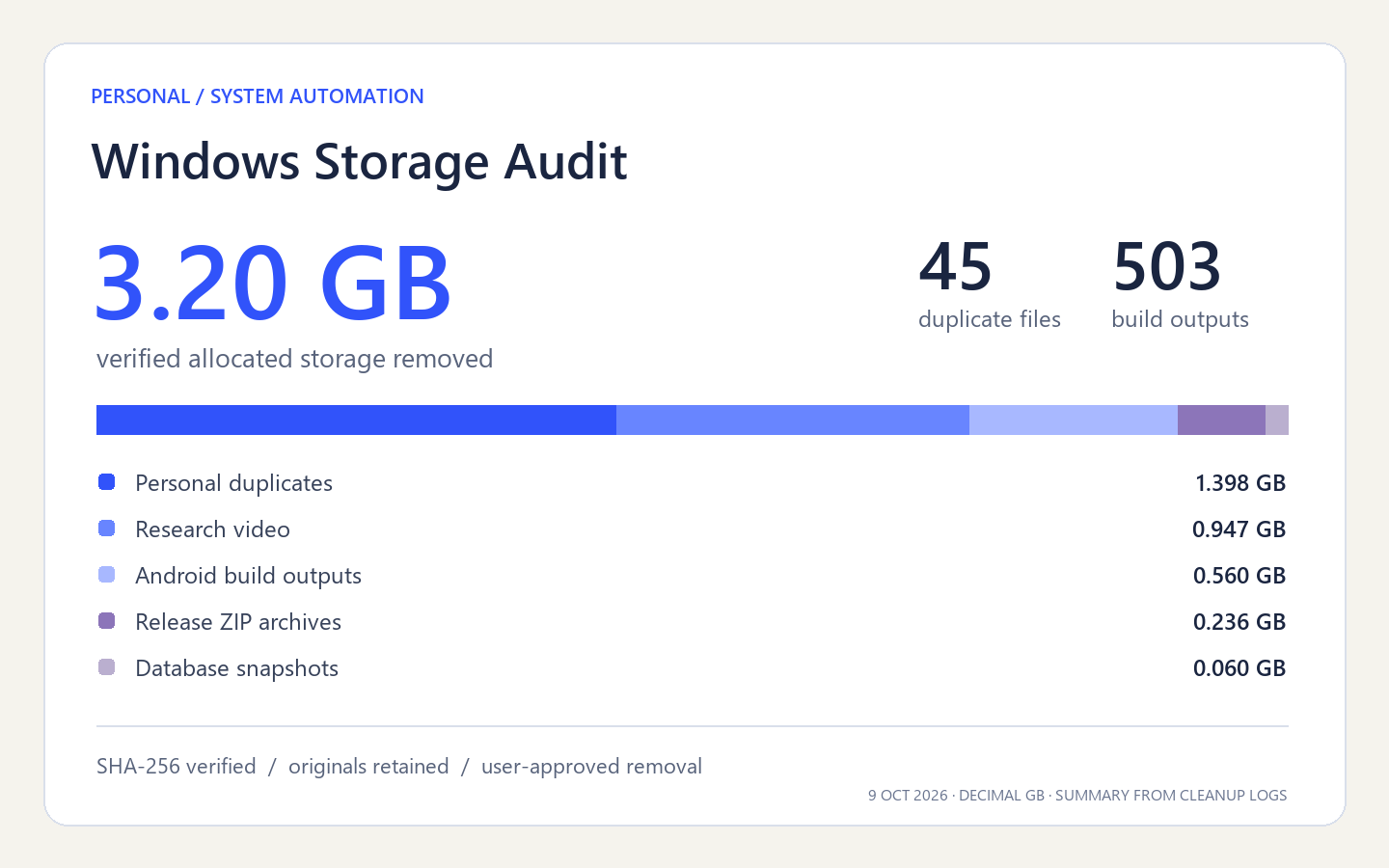
Personal one-off workflow · Windows storage maintenance · October 2026
The problem
A nearly full drive contained duplicate downloads, backup copies and generated build output. Matching names alone could not show which copies were identical or which paths still served an active project.
What this delivers
Two approved cleanup batches removed 45 duplicate files and 503 generated Android build files, releasing 3.20 GB of allocated storage. The retained originals, active database and Android project source were verified present afterward.
What this project does
The workflow inventoried 2,384,755 accessible files on C: and compared candidate duplicate contents for files at least 1 MiB in size. It mapped each proposed duplicate to an original to retain, recorded the expected savings and separated generated Android build output for explicit review. Deletion followed approval and fresh verification.
Inside the project
- Inventory accessible files and group duplicate candidates by size before computing SHA-256 hashes. Content duplicate comparison covered files at least 1 MiB; protected, reparse and cloud locations were skipped.
- Check file sizes, NTFS file identities and hard-link counts so another path to the same physical file is not counted as recoverable duplicate storage.
- Prepare a review table linking each proposed removal to its retained original, with reasons and storage estimates. Keep private file paths and raw manifests local.
- Run two explicitly approved deletion batches, rechecking duplicate pairs immediately before removal and recording the results.
- Remove the approved generated Android build folder separately from duplicate files, preserving the Android source and build configuration.
- Verify that retained originals, the active database and Android source remain present. The completed cleanup removed 3,201,143,568 allocated bytes: 3.20 decimal GB.
Skills & practical experience
Practice turning a storage problem into a reviewable automation workflow: separate content identity from file names, account for hard links, verify assumptions before deletion and check the result against recorded evidence. The implementation was developed with Codex assistance.
The results come from verified local deletion logs for both approved batches. The preview is a summary graphic derived from those logs, rather than an application screenshot. The inventory count describes accessible files; content duplicate comparison was limited to files at least 1 MiB and the stated skipped locations.
Project context
A local cleanup of my nearly full C: drive. This case study documents a completed personal workflow; the scripts and private audit manifests are not published as a downloadable product.
Verified cleanup results
| Category | Files removed | Freed (GB) | Retained |
|---|---|---|---|
| Personal media and downloads | 31 | 1.398 | Identical named originals |
| Research video | 1 | 0.947 | Original dataset copy |
| Release ZIP archives | 8 | 0.236 | One copy of each distinct snapshot |
| Database snapshots | 5 | 0.060 | Distinct backups and active database |
| Android build outputs | 503 | 0.560 | Project source and Gradle files |
| Total | 548 | 3.201 | — |
Decimal GB; generated build outputs are counted separately from duplicate files.