RESEARCH / 2022 PREPRINT
EEG-BBNet
Can brain signals identify a person?
Co-author · August 2022
My contribution
Ratha Rotruchiphong is listed on the preprint with Kamnoetvidya Science Academy affiliation. This was collaborative research; individual implementation responsibilities are not specified in the paper.
Try it · mini version
See what it can do
KVIS research · Co-authored arXiv preprint · August 2022
What this project does
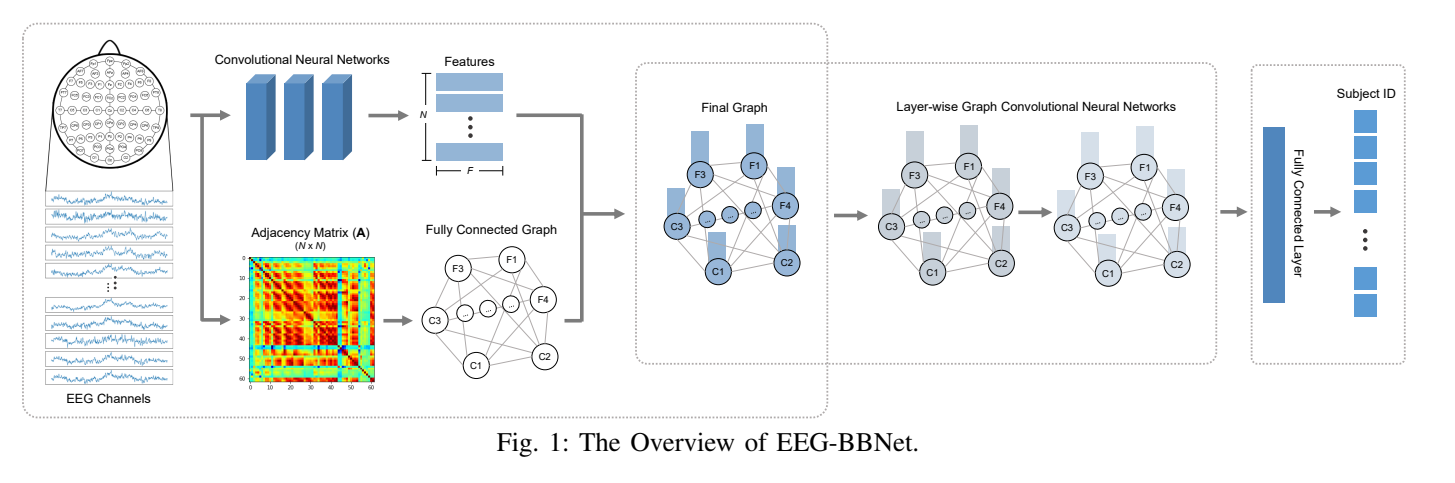
EEG-BBNet investigates identifying people from brain signals. The research combines convolutional features from EEG recordings with graph connectivity between electrodes to classify subject identity.
Inside the project
- Study a hybrid CNN and graph convolutional framework for EEG biometrics.
- Compare electrode-connectivity measures and experimental task settings.
- Evaluate recognition under same-session and across-session conditions.
Skills & practical experience
Research exposure to biosignal processing, graph-based machine learning, experimental comparisons, and communicating results with appropriate limitations.
I am a named co-author on the 2022 preprint. The paper does not allocate individual implementation tasks, so these are research areas covered by the collaboration.
Project context
The framework combines convolutional EEG features with graph neural networks representing relationships between electrodes.
Signals → connections → identity
Motor imagery, event-related potentials (ERP), and visual stimulation provide three evaluation settings. Connectivity measures describe how EEG channels relate.
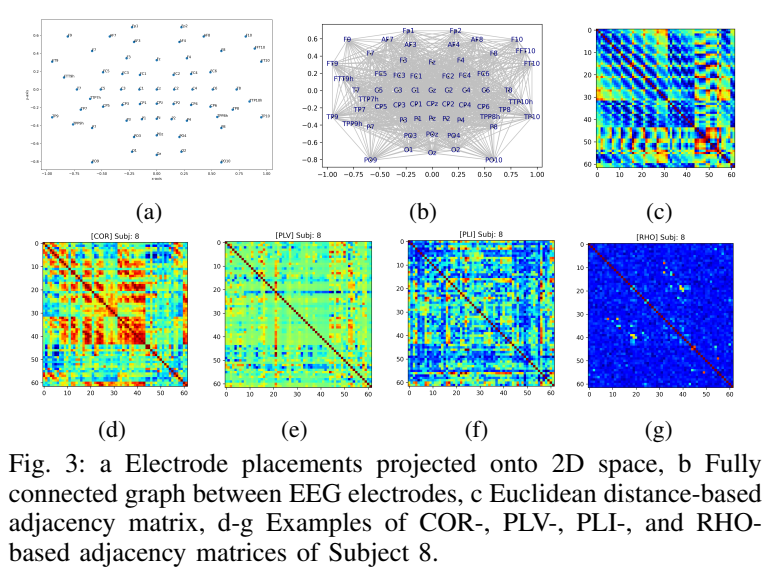
ERP, session I, Pearson correlation connectivity. Correct recognition rate: mean ± standard deviation across five folds.
Across-day performance drops without fine-tuning; these controlled results do not establish real-world biometric reliability.
This showcase covers the 2022 preprint. The later IEEE Sensors Letters article has a revised author list that does not include Ratha.
Figures reproduced without modification from Lakhan et al., arXiv:2208.08901v1 · CC BY-NC-ND 4.0.