PERSONAL / 3D MYSTERY & AI
The Last Dinner
A haunted mansion remembers a massacre. Walk its rooms, enter six witnesses’ memories, and reconstruct the truth before deciding what leaves the house.
Personal project · Game design, engineering & delivery
My contribution
Designed the investigation and branching endings, built the walkable Three.js mansion and memory puzzles, integrated bounded NPC dialogue, and delivered the browser game on AWS with automated checks.
Try it · mini version
See what it can do
Personal side project · Browser game, narrative systems & AI · September–October 2026
What this project does
You arrive at a sealed mansion carrying a tape, a key and a list of names. Its residents repeat fragments of the last dinner. Rather than accept a single account, you explore the house, show physical evidence to witnesses, inspect contradictions inside their memories, and assemble the real sequence of events. The final choice concerns testimony, preserved records and the surviving witness.
Inside the project
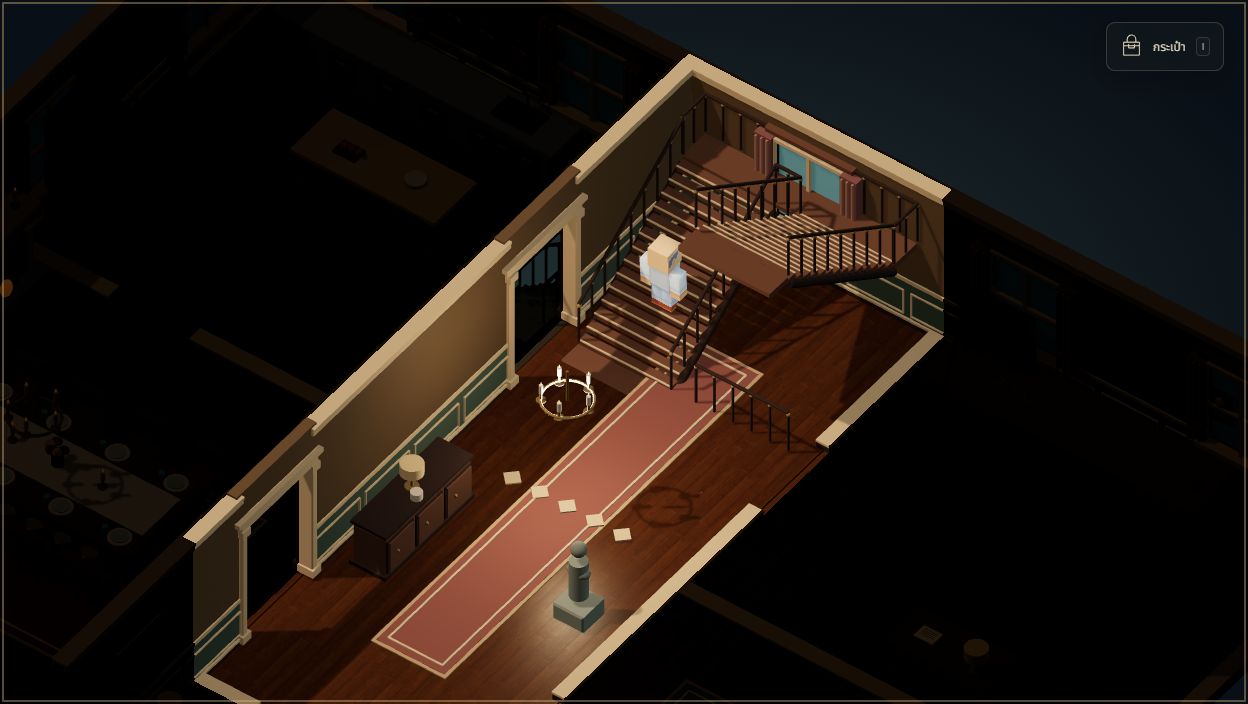
- Explore 14 rooms over a ground floor, an upper floor and a basement, including a concealed chamber. Rooms outside your current location fall into darkness. Continuous stairs connect the floors; there are no stair-transition buttons.
- Control the investigator with WASD or arrows, hold Shift to run, press C to crouch, and E to interact nearby. Drag the mouse to orbit and use the wheel to zoom. The case notebook, evidence, map and settings live inside the investigator’s bag.
- Meet six residents with room routines. Showing the right object opens a memory; compare its second moment, solve an observation, and explicitly record the revealed clue. Fourteen pieces of earned evidence lead to an eight-event reconstruction and a final deduction.
- Choose among three endings. The fullest ending requires securing admissions, protecting original records and respecting the survivor’s choices. Wrong puzzle answers are recoverable; progress saves locally and can be exported or imported.
- NPC questions go through a server-side AWS Bedrock adapter with character-specific knowledge and story boundaries. Authored replies remain available when the model is unavailable. Puzzle rules and evidence gates stay deterministic in JavaScript.
- Deploy static assets through S3 and CloudFront, with a Lambda dialogue API and DynamoDB quota storage. Browser code contains no AWS keys. Request limits, bounded responses and a fallback keep optional dialogue from blocking the investigation.
- Combine room ambience and interaction effects with five CC0 wooden-footstep recordings. Footsteps follow actual movement and floor material; running is faster and louder, while crouching is quieter. Sound begins after a browser interaction.
- Verify a fresh-state route through all 14 clues, six memories, reconstruction, the fullest ending, save/reload and restart. Separate checks cover navigation, continuous stairs, movement input, sound and public delivery.
- Scope: a compact complete investigation, not a commercial AAA release. Saves are device-local, there is no multiplayer, the environment uses stylized assets, and mobile WebGL performance varies by device.
Skills & practical experience
Practice designing a solvable narrative around deterministic state, separating model dialogue from game authority, building physical navigation and audio feedback, and shipping a browser experience with reproducible validation and documented asset licenses.
The gallery shows captures from the running game. The integrated happy-path test earns every clue through production rules instead of importing a completed save. Public code includes tests, story documentation, deployment instructions and third-party attribution; original code is MIT licensed.
Project context
A playable indie browser game with a complete authored investigation. AI adds character conversation; it cannot invent clues, unlock progress or change the established solution. The story deals with murder and coercion without graphic gore.